Wednesday, November 12, 2014

India - An Amazing Glimpse - 12 novembre, 2014

"Live as if you were to die tomorrow. Learn as if you were to live forever" - Mahatma Gandhi

Wow, where do I start? I was invited by my sister-in-law Kathie to join a tour of India and Bhutan led by retired geography professor John Allensworth. It didn't quite fit into my pattern of traveling independently and exploring Europe while we are living in Italy but it was an opportunity that I didn't want to pass up. My good friend friend Anne also joined the tour and I met up with them in Delhi.

The India segment of the tour was only a week so that is why I describe this tour as a glimpse. A country that is the 7th largest in the world with the second highest population of over a billion people cannot be adequately visited in a week. So we were fortunate to focus our visit on a small area in the north known as the Golden Triangle. We began our tour in New Delhi which is the capital of India and is its most populous city with 22 million inhabitants. 

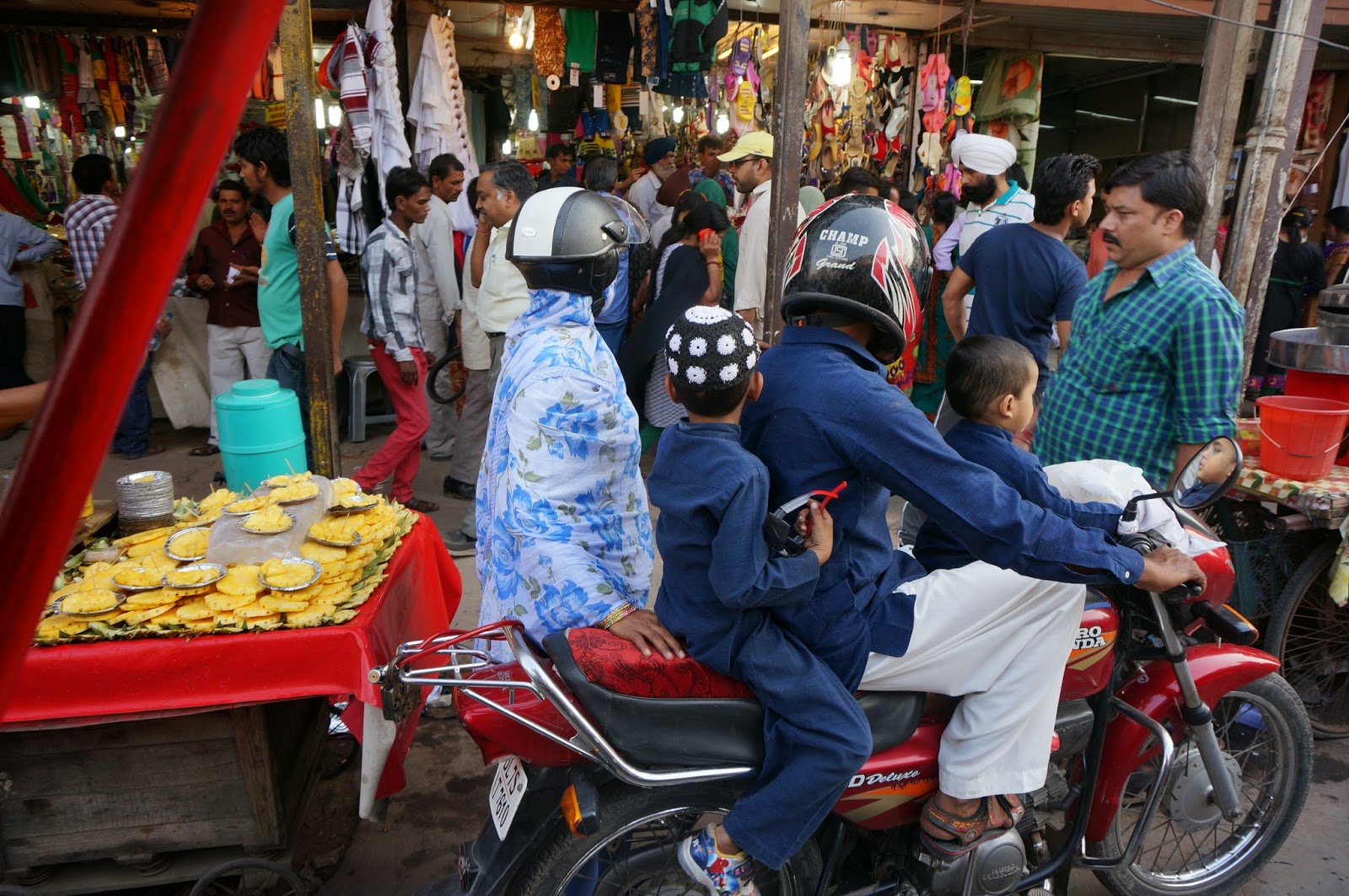
The contrasts of the city were immediately obvious when our bus left the calm, wide streets of the area around the government buildings and our hotel and headed toward old Delhi where a rickshaw ride took us to the Chandni Chawk, an area jammed with people and vehicles of every imaginable type. Goats were being sold in the street for a religious festival, food was being cooked along the streets and there was not an inch of unoccupied space anywhere. But somehow, the surrounding chaos untangled as we maneuvered through the streets and were able to tour Jama Masjid, the largest mosque in India and see temples and the sprawling Red Fort. There is an intense mixture of Hindus, Muslims, Sikhs and Christians all living together in a this massive, crowded city.


Delhi street


An island of tranquility was the Gandhi Museum that commemorates the site where Mahatma Ghandi last lived and sadly also where he was assassinated. It is clear that he is seen as the "Father of India" when you see the crowds of school children and reverent crowds visiting his memorial and museum. Seeing the display of his simple belongings was quietly powerful.


Students at the Gandhi Smriti (museum)

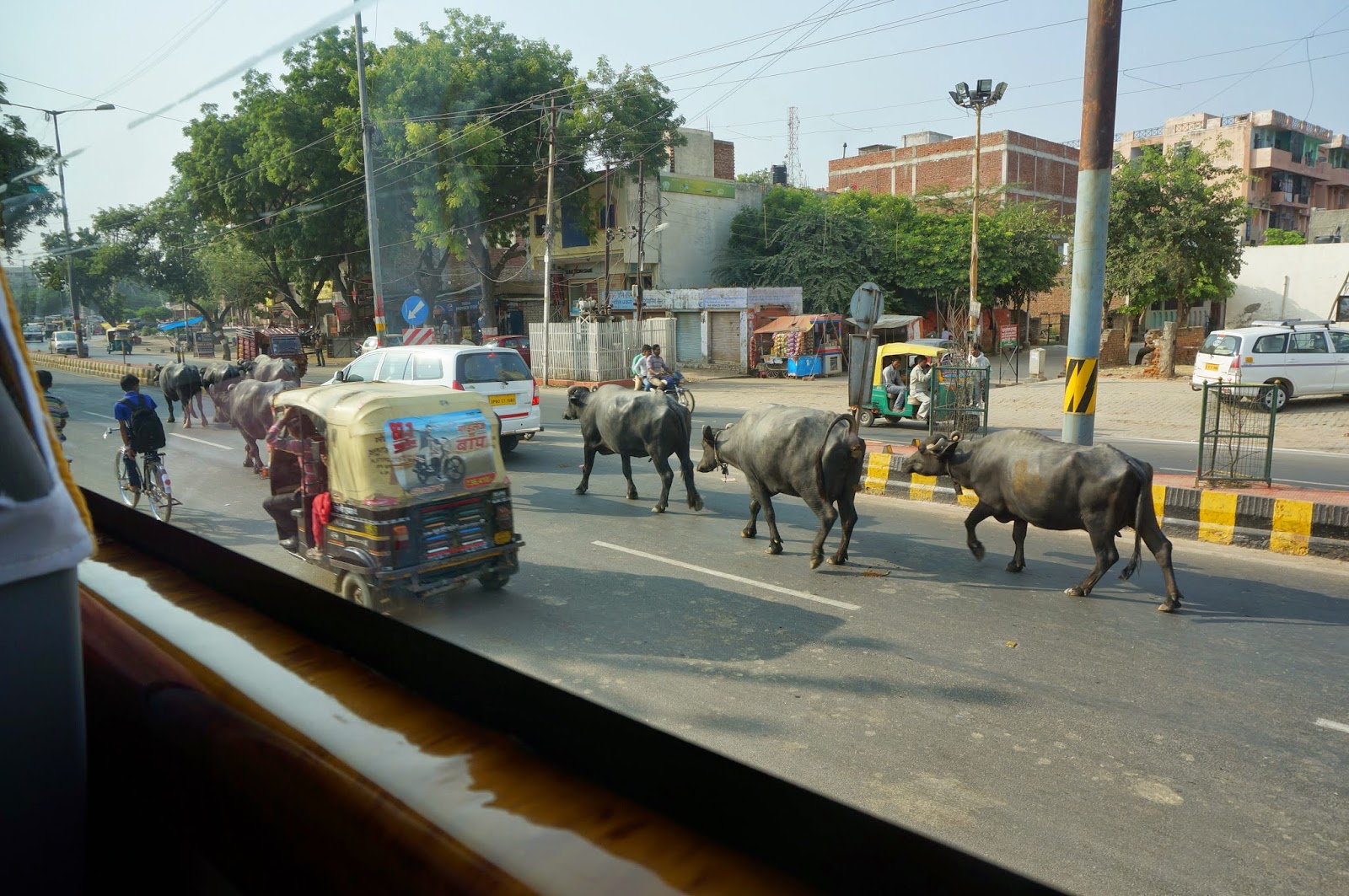
After Delhi, we headed southwest toward Jaipur in Rajasthan. This more arid, rugged countryside has a rich history of Rajput kingdoms and the Mughal empire with many ancient structures still standing. I was fascinated staring out the window of the bus at the daily life along the road. Camels, elephants, horse-drawn carts .... buses with people sitting on the top, trucks decorated like women, a motorcycle carrying a family of four, one never knew what would go by next. And of course, cows wandering everywhere, protected by the beliefs of the Hindu religion. But the more I watched, the more respect I had for the people as I saw the ingenious and creative ways they were using to carry on.

Hawa Mahal -  Jaipur


View from the bus


Abhaneri Step Well


"shopping strip"


Amber Palace

We visited the fort palace of Amber which sits high above Maota Lake and we had the option of taking an elephant ride up the hill to the fort. Anne and I laughed as we rocked back and forth in our seat atop our our young elephant as we wondered how we would top this experience in years to come.
In Jaipur, we stayed at the Taj Jaimahal Hotel which is a heritage hotel that once was a Rajasthan palace dating back to 1745. As we sat outside on a warm evening enjoying a barbecue, listening to sitar music and watching traditional Indian dances in the manicured (and secure) gardens, it was possible to imagine the British colonial days. But just outside that polo field and vast lawns, it is a very different world now.


(photo by street photographer)


Fatehpur Sikri

Then we moved on to Agra, 150 miles to the east. The high point of any trip to this area is a visit to the Taj Mahal and it did not disappoint. We had the good fortune to visit at dawn so we had soft light and cool temperatures. One can't help but be overwhelmed when you pass through the archway of the outer buildings and see this magnificent structure rising before you. The reflecting pools and surrounding gardens are an integral part of the design and even though there were thousands of other (mostly Indian) visitors, there was a feeling of space and peacefulness. The brilliant design allows everyone to find a bench on which to sit and pose in front of this monument to love. This garden-tomb was built to memorialize the beloved and favorite (!) wife of Mughal Emperor Shah Jahan who died in childbirth. 20,000 workers spent 22 years building it with final completion in 1653. The white marble is slightly translucent and it was decorated in a technique called pieta dura where precious and semi-precious stones are inserted into the marble to create flower and pattern motifs. The result is a balanced and sublimely beautiful creation that I feel very privileged to have been able to visit.

Taj Mahal


On our way back to Delhi, we stopped at Humayan's Tomb. This tomb which was built in 1565 for the second Mughal emperor was the inspiration for later buildings including the Taj Mahal. The intricately carved stone screens and geometric details are stunning.

One of my favorite experiences in India was the opportunity to meet and talk with young women. Many of the schoolgirls seemed eager to connect with western women, often asking to pose with us for photographs and eagerly obliging for photos in return. At each of these cultural sights, we met Indian families and groups of students who were friendly and engaging. My week in Indian left me fully aware of the many challenges faced by this country but also so impressed by the openness of the people as well as the beauty and complexity of its culture.


Humayun's Tomb


Monday, September 29, 2014

Sunday - 30 settembre, 2014

Sunday is the day of the week that Italians devote to spending time with family and friends.  Most people aren't home watching sports on television or doing yard work as we often did in the U.S.  Instead they are sitting in multi-generational groups eating and socializing all afternoon while their children and grandchildren play nearby. This past Sunday, we were invited to join friends at "Da Gusto", a seasonal family restaurant on Monti di Gottro high above Menaggio. It was an hour's drive from Como, first along the lake and then up a narrow, twisting road for several miles. Thankfully, we rode with Roberto and Kim. We left in plenty of time so we could get out and walk the last mile or so through an old village and up a scenic trail to the tiny village of Carlazzo.

We had reservations as did about 40 other people. Most of us sat inside because it was a cool day. Roberto told us he has been coming to Da Gusto for thirty years and they have served the same food for all thirty of those years. We didn't see a menu and no one ordered anything, the food just showed up to be served family style in the exact order that Roberto predicted. First the salume antipasto and bread, then polenta, then my absolute personal favorite ...pizzocheri, followed by another type of polenta (uncia), three types of meat (rabbit, chicken and beef), salad, cheese and dessert (crostata).  The meal also included sparkling water, house wine, and grappa with coffee at the end of the meal. The total bill was only 27 euro per person, paid in cash of course.

The meal began around 12:30 and moved at a leisurely pace for several hours. After lunch, people sat outside and visited while the children raucously played and ran around. Our group took a short walk  to a Alpine war memorial that overlooks Lake Lugano on the other side of the mountain. Kim had brought a quilt and pillows - the heavy meal and the warm sunshine definitely were calling us for a nap. I laid down on the hillside and fell sound asleep. Around 4, most of the families were rounding up their kids and heading back down the mountain. We drove back the long way, around Lake Lugano in Switzerland to end up a perfect Italian day.

The village of Naggio

Looking down on a foggy Lake Como

Piazza Maggiore in Naggio


Yummy pizzocheri (buckwheat pasta, potatos, greens, and cheese)

Our table (photo by Mauro Columbo)


Big fun for the kids

Post-parandial naps

Sunday, September 28, 2014

Le Tre Amiche tour - settember 29, 2014

This fall I will celebrate my sixtieth birthday, a milestone that I must admit I am not looking forward to. Anne Morrow Lindbergh called sixty "the youth of old age" so I feel very lucky to have friends and opportunities that keep me feeling young and fully engaged in life. Some years back, two of my closest hometown friends and I made plans to travel to Europe for an adventure to mark our sixtieth year. At that time, I had no idea that I would be living in Italy and we would use my home as the starting point of our trip. So the "three friends tour" with Ellen, Anne and Jeanne became a reality this month and we began with several days of exploring the environs of Lago di Como.

From there, we let Ellen suggest places for us to visit because she had lived in Austria for a year during her university days. She wanted to re-visit the city of Graz where she had studied, as well as Vicenza (Italy) and Munich (Germany) where friends had settled. Since our planned route would pass right through Salzburg, I voted for a stop there so we could enjoy that beautiful city as well. We felt comfortable traveling in German-speaking countries since Ellen could serve as our translator.

Vicenza is located about 40 miles west of Venice and is a medium sized city filled with history and culture. It is best known as the home of Andrea Palladio whose "Pallidium" style of architecture influenced building design in the western world. The Villa la Rotunda which sits majestically on a hill is said to have been an inspiration for our White House. The balance and harmony of the 23 Palladio designed buildings in Vicenza made it an extremely attractive city to visit. We also saw a personal side of the city as we were hosted by Ellen's friends and enjoyed delicious family meals at their table.

Sanctuario della Madonna di Monte Berico (Vicenza)

Villa la Rotonda -1566 (Vicenza)

Palladian Basilica (Vicenza)

The next stop was Graz, the second largest city in Austria. It is known as a university city with six institutions and 44,000 students. The city center is very well preserved with original building facades and beautiful 16th century courtyards that are accessible from the streets. We walked up the steps of the Schlossberg hill to admire the view and the Clock tower that presides over Graz. It was interesting to see some everyday people walking around the city in traditional dress of dirndls and loren jackets.

Painted House - 1742 - Herzoghof Building (Graz)

Schlossberg - 1560 (Graz)


Hauptplatz and Town Hall

Our train ride to Salzburg was stunning as we traversed one of the most beautiful regions of the Alps. At one point, we had to get off the train and take a detour on a bus due to a landslide that had damaged a section of the track. Our hour on the bus turned out to be pure serendipity as we got an even closer view of mountain meadows, hilltop churches and Austrian farmhouses. Anne and I got off in Salzburg and Ellen went on to Munich to visit with a friend.

Salzburg is a gem; it has everything - natural beauty, a pristinely clean and historic Old Town, and a rich sense of culture. We took a tour of Mozart's birthplace, wandered through Mirabell Gardens, and visited the Cathedral and Residence Square. The next morning Anne and I went our separate ways; Anne toured the Fortress and a contemporary art museum and I signed up for the touristy "Fräulein Maria Sound of Music Bicycle Tour". Since I had been first inspired to visit Austria when I was in sixth grade and saw the Sound of Music on a class trip, I was in heaven seeing most of the film locations up close. We rode through the countryside on bike paths and unpaved roads as our guide pointed out the sights that were surprisingly unchanged in the almost 50 years since the movie was made.

Salzburg "Old Town"


Mirabell Palace and Gardens

Leopoldskron Palace

Sound of Music Gazebo at Hellbrunn

That afternoon, we took the train on to Munich where we rejoined Ellen. The days were still warm and the city residents seemed eager to enjoy the last days of summer as the outdoor cafes and biergartens were full. Oktoberfest is still a week away but we saw a preview as we sat with the crowds enjoying their liter sized mugs of beer.

Biergarten in Munich

The next day, Ellen's friend Fritz drove us on a day trip though Bavaria where we again saw the majestic Alps rising before us. Lakes and forestland create beautiful vistas. We toured two castles built by the infamous King Ludwig II who sadly died under mysterious circumstances at age 40 after being removed from his throne for reasons of "insanity". Somehow in the context of our current culture, King Ludwig seemed more like a tragic, isolated figure than a crazy man. Everyone can agree that the castles of which he oversaw the building are spectacular. Neuschweinstein Castle is said to have been the inspiration for Walt Disney's Sleeping Beauty Castle; in fact the preliminary drawings for it in 1867 were drawn by a theatrical scene designer. I had visited this area briefly back in 2008 when I had helped chaperone a school trip so I knew that I wanted to return someday. This time I had the time to hike up the trail to a bridge that provided a great vantage point for photography. We recruited a stranger to take a picture of the three of us there. As I look at the photo, I am so grateful for our friendship and this moment of time. Life is good.

Neuschwanstein Castle 

Linderhof Palace


The park at Linderhof

Le tre amiche 9/19/14 (photo by fellow tourist)

Riding the Rails - 28 settembre, 2014

Trains are my favorite way to travel. Someone else is driving, you can read, eat, get up and move around, all while enjoying the scenery that is passing by the window. In Europe, trains are generally on time and the arrangements well organized. In Italy, that's not always the case; strikes and late trains can disrupt travel schedules but I am learning to relax and be more flexible with my schedule.

During Ellen and Anne's recent visit to Europe, we used trains as our primary transportation. Like most of our visitors, they traveled by train from Milan's Malpensa airport to our neighborhood station in Como. Our plan to visit several places in Northern Italy, Austria and Germany while they were here created a route that was best served by the train system. We had seven days of travel: Como to Milan, Milan to Vicenza, Vicenza to Graz (Austria), Graz to Salzburg, Salzburg to Munich (Germany). We flew from Munich to Milan and then completed the last segment from Milan to Como by train. 


The most interesting part of the travel for me was taking a night train from Vicenza to Graz. We took a local train at 10 PM from Dueville into Vicenza and waited there for the train that was traveling between Milan and Vienna and scheduled to pass through Vicenza at midnight. The journey was to take about eight hours. When the train arrived, we found our sleeping car in which we had two rooms reserved. It was an Austrian train with compartments that each had two bunks that folded out of the wall. An attendant helped fold down the beds and oriented us to the rooms. We were asked to fill out a menu for breakfast and given a "gift bag" with snacks, a small bottle of wine, and water.

The sleeping car
Waiting for the night train


Ellen and Anne shared one compartment and I was the only one in mine. I was aware that there could be another passenger (of the same sex) assigned to my compartment but I was relieved when that didn't happen. The bed was comfortable and I enjoyed falling asleep as I looked out the window and felt the motion of the train. My friends didn't share my experience as they both struggled to sleep that night. In the morning, breakfast was delivered with the news that the train was running about an hour late. We arrived at our destination, a little bleary eyed but ready to hit the ground running.  

After the beds were made up

Watching life go by out the window.

Bischofshofen, Austria

Train travel, while more ecological than flying or driving, is no longer the more affordable option. Our airplane flight from Munich to Milan was actually cheaper than our night train from Vicenza to Graz. But when one takes into account the transportation to and from the airport and the fact that the night train also served as our hotel room for the night, it seemed to be a reasonable expense. Overall, because the experience of traveling together on the train gave us plenty of time to talk and laugh together, it was the ideal method to travel and enjoy the journey.


Scenic views from our window.


Friday, September 5, 2014

Joie de Vivre - 5 settembre, 2014

Geneva's Jet d'Eau

Joie de vivre...the joy of living. Yes, I changed languages just now because for a brief moment last week, we ventured into the French speaking part of Europe. Annie is finishing her three month internship at the World Health Organization in Genève, Switzerland so we took advantage of her proximity and met her there for the weekend.

Switzerland has four official languages, each of which is the primary language in different geographical regions. German is spoken by 65% of the people in the eastern and northern regions, French is the language of 22% in the western region, Italian by 8% in the southern region close to Como, and Romansh is spoken by less than 1% in a tiny southeast corner of the county. Luckily, since my high school French was never worth bragging about, we found that most people in Geneva were fluent in English as well.

Geneva is the second largest city in Switzerland and is located on the shores of Lake Geneva.  The Jet d'Eau which is a symbol of the city has been shooting a plume of water 140 meters into the air for over a century. It is truly a global city filled with many international organizations including many of the main agencies of the United Nations and the Red Cross.  The World Health Organization is a specialty agency of the U.N. with a focus on international public health. I felt privileged to meet some of my daughter's colleagues who represent many different cultures and areas of expertise.

Since the city is also known for being one of the top five most expensive cities in the world, we were happy to cross the border into nearby France with its more affordable prices. Annecy is in the Rhône-Alpes region of France and is known as the Alpine Venice with its scenic canals in the "Vieille Ville" (old town). Flowers abundantly spill out of window boxes and along railings and swans glide along the water in the reflections of medieval buildings. The outdoor cafes were filled from one end of town to the other with everyone enjoying the end of summer sunshine. The lake at the edge of town is surrounded by mountains and has the turquoise hue of a glacier lake. It is quite simply one of the most appealing places I have ever been.


World Health Organization headquarters
W.H.O. meeting room with simultaneous language translation


Annecy


Palais de l'isle
We returned to Geneva and spent the next day exploring the northern shore of Lake Geneva. We stopped in a village and shopped in the Sunday morning market filled with fresh vegetables, wine and bread products and then headed to Montreux which is on the part of the shore known as the Swiss Riviera. We walked 4 kilometers along the wide, flat trail lined with flower gardens that follows the lakeshore to Chateux de Chillon. This island castle is between 800 and 1000 years old and looks like a perfect sand castle guarding the end of the lake. Annie was able to hop on a train to take her back to her apartment in Versoix and we drove up into the mountains, through the San Bernardo tunnel back to Italy. Au revoir for now.

Château de Chillon

Tuesday, August 5, 2014

One Year Later - 5 agosto, 2014


I moved to Italy a year ago this week.  I feel like I am not the same woman who arrived here last August but like any evolution, there have been many variables affecting that transition. Last summer I retired from a full-time career and moved to a foreign country. I went from living in a house on a quiet suburban street to living in an apartment over a cafe in an historic pedestrian district. I couldn't speak the language and I knew no one. I didn't get a car and I didn't know my way around. Dave went to work every morning and I stayed at home. I jumped into deep water.

Today as I reflect on my first year, here are some ways in which I think I have changed:

1. I am living more simply. 
I have been very happy living in our four room apartment. I do miss some of the comforts I had in the United States (such as high-speed Internet), but we are accumulating less stuff, have enough room for guests and are living more economically. And when we want to go away for the weekend, we just lock the door and leave.


2. Feet are the best transportation
I walk or ride my bike just about everywhere. Everything I really need is within a one kilometer radius. I have the time now to shop for what I will use for today's meals. I know the shopkeepers and recognize many of the regulars around town. I listen to the musicians and give coins to the street people I know. I feel the seasons change and notice details like never before.


3. I wander off the beaten path.
All over this region, there are trails that lead up the mountains and around the lake. Many of them are stone mule tracks that have been there for centuries. I don't worry about getting lost because the trails connect villages and generally there is always a bar where you can get a cup of coffee and ask for directions. One finds tiny, old churches perched on the edge of the hillside; you can sit on a bench for a few minutes and enjoy the view.  The sights that stay in my memory are not the ones in the tourist guide but the unexpected beauty that I find in a cemetery statue or on a winding trail.


5. We linger over meals.
Yes, the food here is very good. But it is surprisingly repetitive and predictable. In a restaurant, you generally know what is on the menu before you look at it. But that is fine with me because I can enjoy pasta everyday. The difference is in how it is prepared and that the ingredients are fresh and of a high quality so that the traditional risotto is spectacular or the penne arriabbata has the perfect zing. Nothing is rushed and everyone is relaxed, including the staff.  My favorite days here are when I spend a few hours sharing a meal with friends.


5. I go to fewer places more often.
There are a lot of shops and restaurants in town. Shortly after I arrived here, a neighbor told me that once you return to a place three times, you will be considered a regular. It seems to be an important part of the culture here that one has their "regular" people and places and that has helped me figure out the puzzle of life here. I have some favorite baites up in the mountain villages where we like to make return trips. We hike many of the same trails during different seasons and are amazed by the changing views. Having our familiar places has helped this area feel like home.


6. We have created an extended family.
One of the hardest parts of coming to Italy was adjusting to a culture that revolves around family life while we are so far from our own relatives. Fortunately, now I feel like I have my own Como family made up friends from the International Club, the group of women with whom I volunteer and my hiking group friends. Just like a biological family, there is a diversity of age, personality and role. Many of them are also far away from their families so a strong bond has developed. I no longer feel like I am on a trapeze without a net.


7. I am experiencing La Bella Vita
Life seems very vibrant here and I sometimes wonder why that is. Is it because I have had so many intense new experiences? Is it because I am aware that it is time-limited since I know we will move home to the U.S. in a year or two? Is is because I have the time now to appreciate the life I am living?  I need to discover ways to maintain some of these changes when I return to my life in America. In the meantime, I will appreciate and love this chapter of my life.